Headless CMS: understanding the concept and making the right choice
26 October 2025
Today, content management tools or CMS’ (Content Management System) have become the norm for creating, managing, and updating a website or mobile application. Traditional CMS’, or coupled CMS’, host both the front office, what site visitors see, and the back office, the administrative side, within the same system. In this article, we will explore in detail the advantages of headless CMS’, highlighting two major players in this field: Strapi and Contentful. If your CMS lacks flexibility, scalability, or customization, this article is for you !
What is a headless CMS?
Headless CMS’ rely on an architecture that does not include a front office: content is published via APIs or web services that deliver the content directly to any smart device, website, application, IoT interface, etc.
Do the names WordPress, Joomla!, and Drupal ring a bell? These content management systems proudly powered many sites and blogs for years. Although these monolithic solutions offered turnkey systems, they tightly coupled content management with presentation, suffering from a severe lack of flexibility.
The rise of mobile applications and IoT devices has increased the need to separate content management from presentation, allowing these systems ot meet changing user experience demands, and this is exactly what gave rise to headless CMS’.
This approach thus offers unmatched flexibility, allowing developers to choose any front-end framework (React, Vue.js, or Angular, for example), and adapt to various platforms such as web browsing, IoT devices, and mobile applications.
Moreover, not being tied to a specific front-end framework facilitates the existence of headless CMS’ as services (SaaS), rather than as platforms (PaaS until now). This approach lets developers focus on choosing front-end technologies, while freeing them from maintenance (updates and security), which is handled by the provider, both for the platform (PaaS) and the service (SaaS).
Headless CMS’ have gained popularity during this period, so it’s no surprise they are an integral part of our projects at Kaliop, responding to our clients’ needs.
Headless Experience Conf' - Strapi, an innovative CMS
Headless CMS, or the power of nested design
Watch nowTraditional and headless solutions differ in their own characteristics, from interface organization to data processing. In this article, we offer an overview of the substantial differences between these two types of solutions.
Headless CMS: a nested design
Headless CMS’ adopt a modular approach to content management, focusing on separating content management from its presentation.
This architecture allows efficient content management, while offering the possibility to add extra features according to the specific needs of the project.
Within this architecture, it is possible to nest specialized modules, such as a search engine, which can interact directly with the content stored in the CMS, thereby enhancing the system’s capabilities without affecting its basic structure.
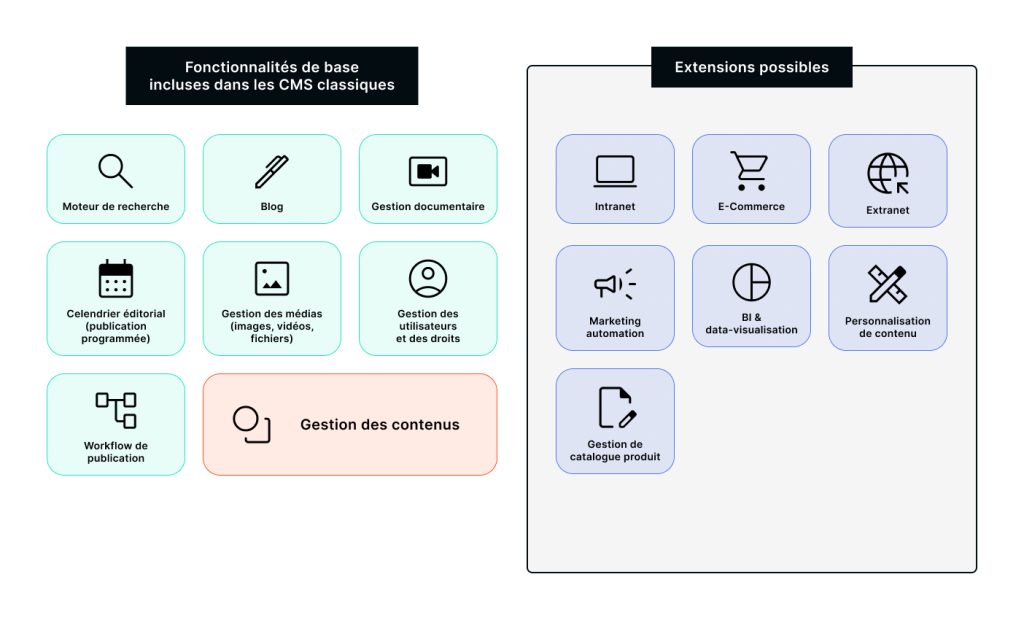
Example of CMS broken down into blocks :

Traditional CMS: the all-in-one choice and its limits
Traditional CMS’ are designed as integrated solutions for website creation, offering a wide range of features to meet diverse needs. Typically, these systems handle user management, media libraries, the user interface (through themes and templates), and include features such as internal search engines and, in some cases, e-commerce tools.
The ambition of traditional CMS developers has been to provide as comprehensive a set of features as possible to satisfy a broad range of applications, from website creation to product catalog management and intranet development, in order to maximize their market applicability.
Organization of a traditional CMS
How does a headless CMS differ from a traditional CMS?
In a project using a traditional CMS, the goal is to select the system that best meets the overall project requirements, considering short, medium, and long-term objectives. Sometimes, specific requests require going beyond the standard capabilities of a traditional CMS, leading to the integration of external components to fill missing features, although integration can prove complex.
For projects based on a headless CMS, priority is given to the solution offering the best performance in terms of integrable features and the most suitable economic model. Headless CMS’, often offered as Software as a Service (SaaS), present variable pricing influenced by factors such as the number of users, languages, workspaces, and managed content, making their cost more variable.
The final decision must therefore be based on a careful evaluation of the most efficient and economically viable solution for the given project, considering potentially significant cost variations. The choice of a CMS, whether traditional or headless, should ideally correspond to the specific needs, organizational structure, and budget constraints of the project.
Why use a headless CMS?
It is now time to delve into the three main advantages of headless CMS’.
- Flexibility : the main asset of headless CMS’ lies in their flexibility. By separating content management from presentation, these systems offer developers the freedom to choose the front-end framework that suits them best, thus opening the way to innovation and experimentation with technologies such as React, Vue.js, or Angular.
Consider, for example, a website built with NuxtJS for the front-end, while the back office uses React, and an associated mobile app is developed in Flutter. This setup remains seamless for the end user, who still benefits from a smooth and consistent experience. In short, the modularity of headless CMS’ enables the design of personalized user experiences, freed from the limitations inherent to monolithic systems. - Scalability : managing the expansion of a website is a major challenge that headless CMS’ simplify for developers and companies. By decoupling content from its presentation, they facilitate maintaining high performance, even as the site grows.
- Containerization technologies like Docker play a crucial role in this ability to scale. These tools allow rapid expansion of headless CMS’ and efficient resource management, ensuring constant performance even during traffic spikes.
- High availability is another essential aspect. By strategically distributing different parts of the CMS across various servers or geographic zones, headless CMS’ guarantee increased resilience. Thus, in case of technical issues or hardware failures, service continuity is maintained.
- Kaliop regularly integrates these scalability principles into e-commerce projects, ensuring uninterrupted access and transactions for users, even during peak usage.
The combination of these elements makes headless CMS’ a sustainable solution for growing projects, offering optimal performance and continuous availability. - Customization : headless CMS’ play a key role in facilitating customization, allowing developers to freely design presentation logic to create tailor-made user experiences.
They open the door to a wide range of customizations, from complex editorial content to elaborate e-commerce sites and interactive applications. For example, a website dedicated to French heritage could offer visit recommendations tailored to the user’s specific interests, while an online store could display products based on past purchase preferences. Platforms can thus provide personalized content that increases user engagement and interest. - Furthermore, headless CMS’ simplify the creation of personalized conversion paths for e-commerce sites, allowing content adjustments based on user skill level or offering multilingual experiences that automatically adapt to the user’s language and regional preferences. This flexibility meets particular demands of users and businesses, fostering more relevant and effective interactions.
Which headless CMS to choose?
Besides Contentful and Strapi, other headless CMS’ like Prismic, Sanity, and Hygraph offer unique features, such as Hygraph’s native GraphQL support or Sanity’s conflict-free real-time collaboration. The choice of a headless CMS should be based on key criteria such as cost, scalability, quality of customer service, and specific project needs including flexibility and multichannel management.
It is important to consider the user interface and learning curve: some systems, like Prismic, are known for their ease of use, while others, like Strapi, offer great flexibility but may require a longer adaptation period. Indirect costs, such as custom development, maintenance, and potentially training, as well as hosting choices, also influence the total cost.
Ultimately, selecting the appropriate headless CMS involves carefully assessing your requirements, technological compatibility with your team, and overall budget to ensure successful and efficient integration into your digital ecosystem.
Strapi: the open-source headless CMS
Strapi, as a headless content management system (CMS), has emerged as a versatile and powerful solution for developers and companies seeking to push the limits of online content management. Here are some of its characteristics :
- Open-source : as an open-source solution, Strapi offers full control over content and architecture, allowing inspection and modification of source code as needed, a flexibility not available with SaaS solutions.
- Extended flexibility : Strapi stands out for its adaptability through a plugin system, allowing deep customization beyond basic features. It is also possible to extend its core, based on the Koa framework, for specific needs.
Intuitive content management: with its clear user interface, Strapi facilitates content creation, modification, and organization, promoting effective collaboration between editorial teams and developers. - Scalability : Strapi’s distributed structure facilitates scaling by adding servers, ensuring high availability and sustained performance, unlike centralized cloud solutions.
Advanced customization: Strapi enables the development of unique user experiences with advanced customization features, including dynamic zones for diverse projects, from showcase sites to e-commerce platforms. - Community and support : Strapi benefits from an active community and rich documentation, ensuring continuous support and ongoing platform improvement.
- Self-hosting: the option for self-hosting particularly appeals to those seeking to avoid licensing costs, though it entails managing server security and maintenance.
In summary, Strapi establishes itself as a top choice for those seeking modern, flexible, and performant content management. Whether for small projects or complex enterprise applications, Strapi provides the tools needed to realize innovative ideas with agility and efficiency.
Contentful: the swiss army knife
With a broad range of integrated features, such as version management, content publishing in various states, data synchronization, and offline content management, Contentful stands out. Where other CMS’ require extensions or custom development, Contentful offers these core capabilities.
- Security : as a cloud solution, Contentful places great importance on security, offering multi-factor authentication, data encryption, and protection against DDoS attacks.
- Search features : Contentful’s search tools enable detailed exploration through full-text, faceted, and geolocated search, facilitating content organization and relevance.
Intuitive content management: Contentful’s user interface simplifies content creation, organization, and publishing, making collaboration between editorial teams and developers smooth without advanced technical skills. - Scalability : contentful allows easy addition of new content types and fields to support project growth without constraints, ensuring stable performance even under heavy load.
- Advanced customization : developers define complex content models to fit specific project needs, whether for websites, mobile apps, or e-commerce platforms.
- Dynamic ecosystem : with an active community, comprehensive documentation, and regular updates, Contentful relies on a solid ecosystem. The platform constantly evolves to integrate new features and continually meet new digital industry demands.
In summary, Contentful stands out for its rich out-of-the-box features, flexible content model, and advanced search capabilities. Its adaptability and ease of integration make it an excellent choice for highly customized projects.
Adopting a headless CMS represents a significant evolution in digital content management, whether Strapi, Contentful, Prismic, or others. Each system offers unique advantages, but the ultimate choice depends on the specific needs of your project. While Contentful excels with robust multichannel management, Strapi shines through deep customization, and Prismic through ease of use.
At Kaliop, our selection criteria do not rely on our developers’ preferences or affinities. The CMS choice should not be made arbitrarily to avoid the risk of a CMS that only partially meets expectations. We prefer to analyze case by case the client’s expressed needs, context, and stakes. Then, we recommend the headless CMS that seems best suited to their needs and ensures future flexibility.
If you wish to discuss with a CMS solutions expert, please contact us directly via this form.
Headless Experience Conference - Contentful, an innovative headless CMS
Headless and composable architecture

Expert mobile et lead dev
Comments