- [ Tech ]
- [ Back for Front ]
The Backend-for-frontend Concept

Baptiste Leulliette
Published on January 9, 2025 - 2 min read
Over the past few years, the term “Backend-for-Frontend” (BFF) has been used more and more, mainly in the context of migrating technical architectures toward microservices and micro-API approaches. This type of architecture, which we develop at Kaliop, is part of a broader replatforming and composable architecture strategy that allows organisations to modernise their systems while at the same time benefiting from greater flexibility and adaptability.
This term originates from an approach aimed at optimising communication between the various applications within a distributed system.
It involves providing tailored communication for each type of user-facing frontend, whether mobile, web, IoT, or beyond. The goal is to reduce development complexity by centralising business logic, aggregating multiple services, and delivering data in the most flexible way possible.
Backend-for-frontend: the concept, in a technology-independent manner
The idea is based on a clear separation of responsibilities: the BFF acts as the intermediate layer between the frontends and the backend side of a project, including storage layers and other external APIs.
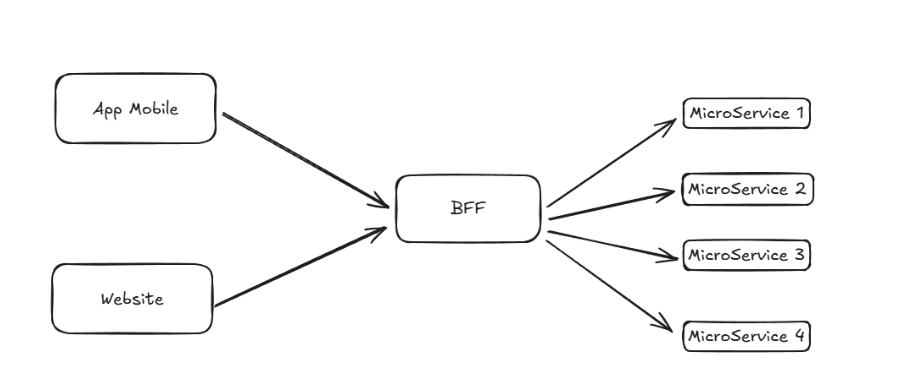
Let’s consider a scenario in which a user interacts with an order management application. Without a BFF, the frontend must separately call the “Users”, “Orders”, and “Products” services. This results in multiple requests as well as manual data aggregation.
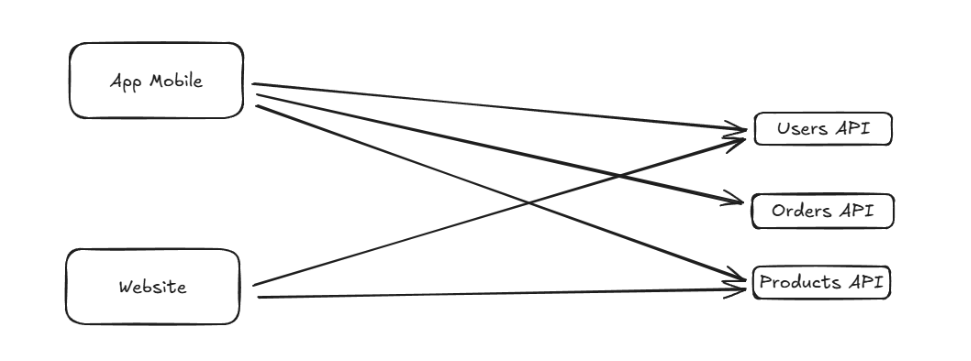
With a BFF in place, the frontend sends a single request, and the BFF is responsible for communicating with each service, assembling the responses, and returning a ready-to-use format.
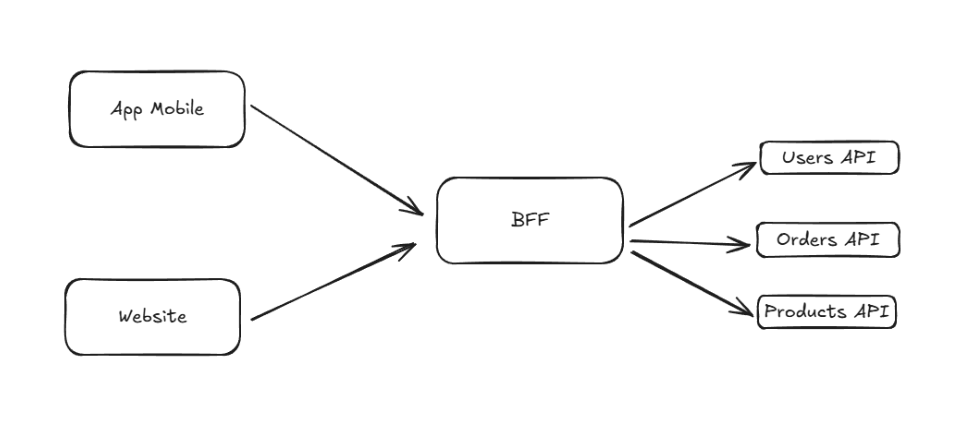
This abstraction works independently of the underlying technology, whether it involves REST or GraphQL services, to name two examples among others. What changes is the way data is retrieved, aggregated, and returned.
The objective is to provide a single, optimised entry point for each type of frontend.
In a web context, let’s briefly compare why we tend to favour GraphQL over REST.
Are you considering modernizing your front-end/back-end architecture?
Our teams design and deploy tailored Backend-for-Frontend (BFF) architectures.
Comparison between REST and GraphQL
REST and GraphQL are two common paradigms for implementing an API interface.
While REST relies on fixed endpoints with predefined responses, GraphQL provides a single-entry point and allows HTTP clients to explicitly specify the data they want.
If we go back to the example above, in both cases an endpoint will need to be implemented to retrieve users together with their orders and associated products.
Let’s assume the REST endpoint returns this data:
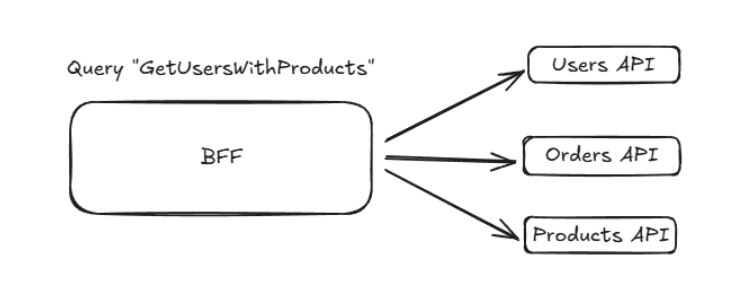
Let’s imagine that the mobile application only needs to use part of the response, in this case, the orders without the product details. In a REST context, backend over-fetching is inevitable because REST enforces use of the output model.
By contrast, GraphQL allows clients to select just the fields they request, enabling the generation of the following data:
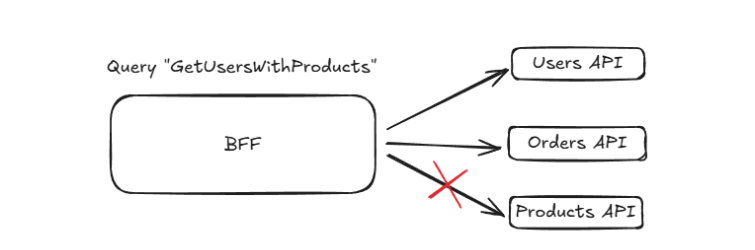
This approach prevents data over-fetching, reduces response time, and optimises the returned payload.
Practical implementation
GraphQL, created by Facebook to address the issues mentioned earlier with REST, provides a comprehensive ecosystem with a standardised front-to-back communication, as well as a wealth of tools for monitoring, caching, API federation, and more.
Implementation begins with the definition of a schema, which exposes strongly typed data models. Returning to our e-commerce example, this could be represented by the following schema:
Backend-for-Frontend: an optimised approach for a modern architecture
The contributions of a BFF are undeniable, providing standardised data delivery, the ability to establish clean and optimised communication between the different layers of your project, and better separation of responsibilities.
A BFF implemented using Apollo GraphQL enables performance optimisation, both at the network level by avoiding over-fetching and thanks to the various caching options.
Enhanced communication between frontend and backend developers is often observed, thanks to the adoption of a shared schema.